Bachelor Program

Programs of the Department

  1. Bachelor Programs for undergraduate Public Health

Program Objectives:
General Objective
  • To produce competent Public Health professionals who undertake promotive, preventive, curative, and rehabilitative services including management and implementation of PHC services compatible with the needs of the population
Specific Objectives
  • Assessing community health needs and prioritizing identified problems
  • Intervening on the identified health and health-related problems of the community Promoting health, preventing and controlling disease
  • Providing curative and rehabilitative health services
  • Managing health services and health offices
  • Undertaking operational and problem-solving research
  • Having professional attitudes, ethical conduct, and social responsibilities;
  • Undertaking Caring, Compassionate, and Respectful service with ICT and entrepreneurial skills.

Graduate Profiles:

A graduate Public Health Professional, given the knowledge, attitude, and skills acquired from the program is expected to fulfill the following minimum requirements:

  • Assess community health needs, prioritize, identify problems and Intervene in the identified health and health-related problems
  • Plan, implement and evaluate public health intervention programs in Health Care settings.
  • Collect, document, process, analyze, and disseminate health information
  • Participating in health promotion, prevention, and control of diseases
  • Provide curative and rehabilitative services
  • Provide early diagnosis, basic treatment, and referral of a difficult case
  • Provide comprehensive outpatient and inpatient services.
  • Perform minor surgical and obstetric procedures
  • Perform medical diagnostic and therapeutic procedures
  • Mobilize individuals, families, and communities for different public health activities
  • Undertake operational health research and involve in the data management process
  • Organize and participate to prevent and control disasters and emergencies
  • Promote and engage in inter-sectoral activities

Program Profile

Selection and Admission Criteria:

  • Candidates must:

  • Meet the set criteria of higher education to join the higher learning institutions

  • Be physically fit (at least the candidate should be physically healthy and capable of undertaking the four techniques of diagnosis of disease in clinical medicine i.e inspection, palpation, percussion, and auscultation)

  • Female candidates will be encouraged

Ø Total credit hours, ECTS, and Duration of the Program:

·       Total credit hours: 177

·       Total ECTS: 295

·       Duration of the training: Four years

o   First year: 2 semesters /year

o   Second, Third and fourth year: Year-based (Year based Academic calendar) 

Graduation Requirements:

  • Successful completion of 177 credit hours/295 ECTS/ with a minimum cumulative grade point average (CGPA) of 2.0 is mandatory for graduation
  • No “F” grade will be accepted in any course for
  • Student should score “C” grade and above in all core courses/modules.
  • The student shall score a pass mark (³50%) on the final comprehensive qualifying exam. Failure to pass will result in delay for three months and take re-exam. The students shall fill the identified gaps. In case the students fail for the second time s/he should delay for next three months and take the second re-exam. If s/he fail the second re-exam gaps be identified by the institution and academic decisions should be given.

Criteria for Promotion and explanation:

  • Promotion will be conducted every semester for year one and yearly for year two, three and four.
  • Pass mark in all core courses will be at least a ʽʽC” grade.
  • Any student who scores ʽʽF” in any course will repeat the course.
  • Students will be promoted to the next level provided that they score minimum of “C” grade in all core courses and practical attachments (clinical courses and community attachments/practices). A student who scores ʽʽC-, or “D” or “FX’’ grade should not be promoted to the next level. Re-examination on failed parts is allowed within 2weeks time if he/she scored only one ʽʽC-“, or ʽʽD” or FX” in core clinical courses or community practices/attachments. However, if s/he scores two “C-”, or D or ‗FX‘s s/he shall continue the internship but re-attachment is a must. Failure after one single chance of re-examination also leads to repeat course.
  • If a students‘ scores more than two “C-”, or D or ‗FX‘s or a “D” and an “F” in core courses s/he shall repeat the year.
  • Except for core courses, any student who scored “Fx” shall take remedial exam on subjects failed irrespective of the CGPA achieved. Remedial exam shall be allowed only once. Any student who fails the remedial exam will repeat the subject/s failed. If the student declares failure for the second time decision will be made by the academic commission.
  • If there exist, student should only be registered requisite course/s if s/he scored a minimum of “C” grade in the pre-requisite core course/s
  • Students will be promoted to the next level (SGPA, CGPA) based on Universities Senate legislation

Degree Nomenclature:

  • Up on successful completion of the program:

In English: “Bachelor of Science Degree in Public Health”

In Amharic: “የሳይንስ ባችለር ዲግሪ በሕብረተሰብ ጤና” will be awarded.

  1. Bachelor Programs for Post basic Family Health

Program Objectives:

The objectives of family health training program are;

  • To promote and maintain optimum standards of family professional care and practice in family setups with respecting of patient/clients value, culture, belief and dignity
  • To promote safe and healthy lifestyle environments for clients and family
  • To take part in the administration, management and organization of family professional care in the family
  • To help patients manage acute and chronic illnesses
  • To conduct an operational research for the provision of evidence based family professional care
  • To participate in educational process for the personal and professional development

Strategies

  • Collaboration with different stakeholders; like departments, health facilities, institutions and program organizers
  • The teaching process will follow community based Education philosophy; like CBTP and TTP
  • Training should be given using skill laboratory and clinical attachment sites
  • There must be preceptors at each affiliated hospital/communities

Graduate Profiles:

  • Keep measures to prevent the spread of infection, and apply principles of infection prevention and control.
  • Demonstrate the ability to lead, coordinate and support implementation of activities
  • Monitor and evaluate the progress of implementation of activity
  • Analyze development of the child, adult and older person the life course approach
  • Apply appropriate learning principles, teaching methods and educational theories to educational activities include family, volunteers and caregivers in teaching and education
  • Involve in disease control, prevention and rehabilitation activities in the community
  • Generate, analyze and interpret data for solving family health problems
  • Describe the physiology of pregnancy, labor and puerperium, gynecological problems, lactation and management of breast feeding and family planning
  • Describe the general principles of management of infectious and chronic disease and implement  professional process at individual, family and community level
  • Assess determinants of community health
  • Apply primary, secondary, tertiary level of prevention
  • Conduct community diagnosis (including profiling) and apply community-based interventions

Program Profile:

Selection and Admission Criteria:

Admission to this post basic program in family health professional requires

  • TVET level 4 Health Extension worker (HEW) and nurses having diploma who are working

as urban health extension with COC certificate from a recognized institution

  • A minimum of 2 years full-time service
  • One recommendation letters from Regional Health Bureau (RHB) or City Administration HB
  • The applicant must successfully score 50% to pass mark.
  • Sponsorship letter from sponsoring government institution

Intake capacity

Intake will be determined by the need of Ministry of health and training capacity of training

institution annually.

Total ECTS and Duration of the Program

  • Total ECTS: 167
  • Duration of the training: Two and half years

Graduation Requirements:

  • Successful completion of 167 ECTS with a minimum cumulative grade point average (CGPA) of 2.0 is mandatory for graduation
  • No grade of “F” will be accepted in any module for graduation.
  • The students should score “C” grade and above in all core modules. All “D” grades in these core modules are subject to repetition of the module.
  • Scoring a pass mark (> 60%) on the final comprehensive qualifying exam on core courses module; otherwise delay for three months.

Criteria for Promotion

  • Promotion will be conducted every semester (at the end of a year for year based modules)
  • Promotion to the next level will be guided by the college legislation

Degree Nomenclature:

  • Up on successful completion of this program the graduate will be awarded “Bachelor of Science Degree in Family Health” in English and “የሳይንስ ባችለር ዲግሪ በቤተሰብ ጤና” in Amharic.

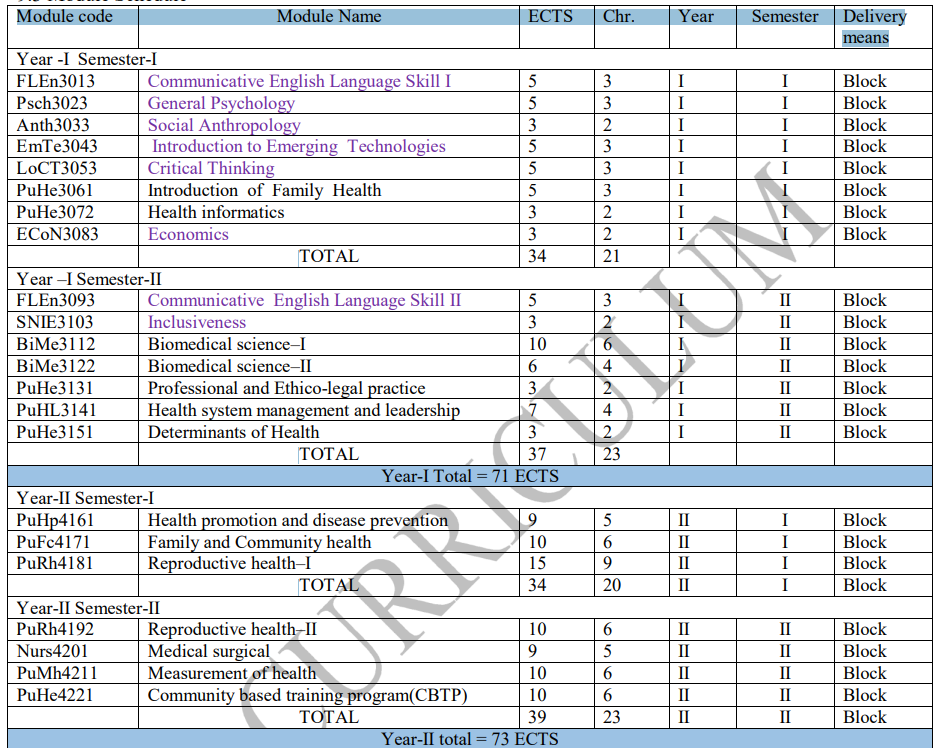
Course Break Downs:

Harmonized Post Basic Curriculum for the Bachelor of Science Degree in Family Health, Program
III. Postgraduate Programs:

MPH in General Public Health

Program Objectives:

General objective:

  • The general objective of the program is to train and produce a high caliber public health professionals outfitted with skills and knowledge to promote the overall well-being and health of the pastoral and agro-pastoral society in the region and Ethiopia as well.
  • Hence, this will intern contribute to the reduction of poverty and prevention and control of diseases of public health importance including the curtailing of the HIV/AIDS pandemic.

Specific objectives:

The specific objectives of the program are to train public health professionals who can:

  • Manage health services and programs at the woreda/district, regional and national levels
  • Undertake basic and operational researches that would contribute to solving community health problems
  • Tolerate responsibility at federal, regional states, international organizations, and different stakeholders
  • Teach health science training programs at various levels.
  • Develop innovative approaches and strategies in community-specific programs for the safeguarding of Health and prevention of diseases.
  • Equip with the capability to be a resource person for the institutions as well as the pastoral and agro-pastoral community at a large in all matters related to public health.
  • Assess community needs for health programs, design, coordinate, implement and evaluate the effectiveness of health programs at various levels of health delivery systems.
  • Act as a core member of the health team, contribute to the alleviation of poverty and prevention as well as control communicable Diseases.
  • Involve in national, Regional Health Policy Design, Development, and Implementation

Graduate Profiles:

Up on graduation, graduates of the MPH program will have the following competence:

  • Provide effective technical as well as managerial strategic leadership (in preventing diseases and advocating and promoting health)
  • Promote and protect the population’s health (public health program priority setting)
  • Proficient in assessing, evaluating, and developing health and health-related programs to develop health policies, guidelines, and regulations.
  • Capable of conducting different types of research at different organizational levels of the country to solve the health problems of the community.
  • Expert at providing consultancy services in the control and prevention of health and health-related problems.
  • Cooperative with other professionals to forecast, prevent and control epidemics of diseases of local as well as global nature.
  • Knowledgeable and understanding of the public health issues in developing country settings, including Ethiopia.
  • Ethically manage self, people, and resources (apply the ethical principles and values of public health practice

Admission Requirements:

In addition to the general admission requirements for postgraduate programs stated in the senate legislation of Samara University, applicants should have a minimum of a first degree (BSc) in Public Health/Health Officer, Medicine, or paramedical fields (Nursing, Environmental Health, Occupational Health, Midwifery, Laboratory, Optometry, Anesthesia, Physiotherapy, Health Education, or Pharmacy) in accredited university/University College or College. The program is also open to those with first degrees (Bachelor’s) in other fields such as Veterinary Medicine and Biology which will be evaluated individually on the bases of the applicant’s work experience, courses taken and training taken. Applicants for the program are preferred to have two years or more relevant work experience, but this is not mandatory. They should also be physically and mentally fit to be enrolled in the MPH program.

  • Preliminary screening shall be based on the following criteria
    • A minimum CGPA of 2.00 from a first-degree or 3.00 from a second degree
    • Two letters of recommendation (at least one should be from a university academician)
    • Sponsorship letter from employer/sponsor for sponsored students or declaration statement for self-sponsored applicants
    • Their background education stated in the first paragraph of the admission requirement
  • Applicants who pass the NGAT and qualified to pursue graduate studies in accordance with the standards set by the FDRE, Ministry of Education will be invited to the program
  • The minimum qualifying mark will be 60%. Female applicants are encouraged to apply

and they will be given priority.

  • As the medium of instruction is English, applicants whose medium of instruction is not English for their first degree would be required to bring a valid English language test.

Graduate Requirements:

A student to be graduated with “Masters’s Degree in General Public Health, each candidate should satisfy the requirements stated below as well as those graduation regiments stated in Samara University Senate legislations.

  • Student achievements in any of the courses shall be graded as per the cut-offs stipulated in the Samara University Senate Legislation.
  • The academic status of the students shall be determined periodically as per the rules and regulations of the Samara University Legislation after the completion of minimum credit hours.
  • A graduate student must sustain a minimum SGPA and CGPA stipulated in the Samara University Legislation throughout his/her study period in the program.
  • The respective Department Graduate Committee (DGC), in consultation with the department academic committee, shall determine the academic status of graduate students based on the Samara University Legislation.
  • Students must complete all the required courses, defend their thesis successfully, and achieve a CGPA of 3.00

Degree Nomenclature:

Up on successful completion of the program, the degree nomenclature will be:

  • In English “Masters Degree in General Public Health” as well as
  • In Amharic “የሁለተኛ ዲግሪ በህብረተሰብ ጤና አጠባበቅ”